6 hotels · 3 pairs
Art Hotels
Hotels where the building came first: conversions and nineteenth-century houses in Germany.
Six hotels in Germany, set out as three pairs. Each one is here because of its building: a bath house from 1902, a lakeside house from 1909, two nineteenth-century city hotels, an estate on the Baltic and a villa in a hill park. We compare hotels from public sources, and we look at the structure before anything else.
Hotels with art on the walls but nothing to say about the building do not go in this section. Neither do new-build design hotels, however carefully they are finished.
Pair A1 — City conversion against city classic
Both hotels are city buildings from the early twentieth century, and both were built for a public that arrived on foot. One was a bath house that became a hotel and kept its pool. The other was built as a hotel and has never been anything else. The difference is what the building was originally asked to do.
01
Hotel Oderberger
Berlin, Prenzlauer Berg
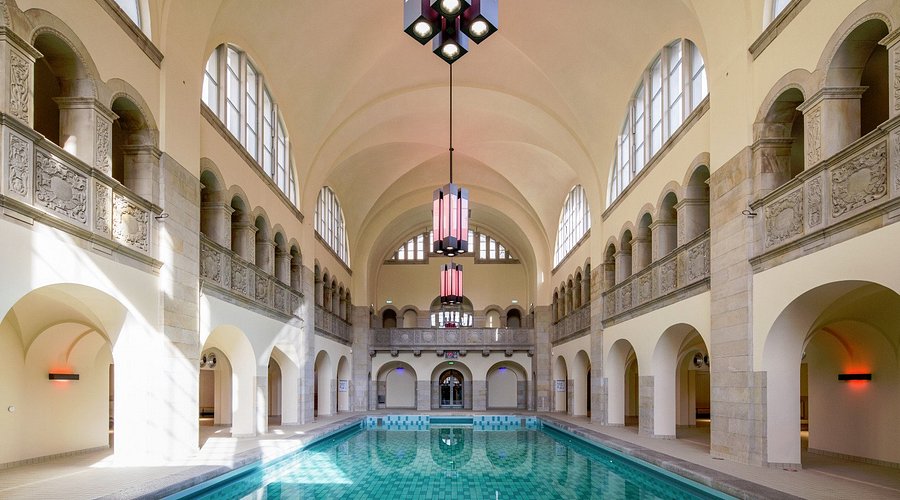
01 — Hotel Oderberger. Berlin, Prenzlauer Berg
The hotel
Hotel Oderberger occupies a public bath house that opened in 1902 in Prenzlauer Berg. The house was built as a municipal facility, and the brick front still reads that way from the street. The swimming hall is the centre of the plan. The pool from 1902 is still there, under a high vaulted ceiling with galleries on both sides, and guests swim in it. Rooms sit in the wings around that hall, so the layout follows the old building rather than a hotel grid. Ceilings are tall, windows are large, and the corridors keep their first proportions. The location is residential Berlin: Oderberger Strasse is a side street of flats and small cafes, a few minutes from Kastanienallee. Mauerpark is close enough to reach on foot before breakfast. The hotel works as a base for the north of the city, and it also works as a building to walk through for an hour.
Good to know
The swimming hall is also used for events, so it is not open at every hour of the day.
Side by side
- Setting
- City side streetCity lakefront
- Building
- Public baths, 1902Grand hotel, 1909
- Season
- All yearAll year
- Getting there
- U-Bahn and tramWalk from Hauptbahnhof
02
Hotel Atlantic Hamburg, Autograph Collection
Hamburg, an der Alster
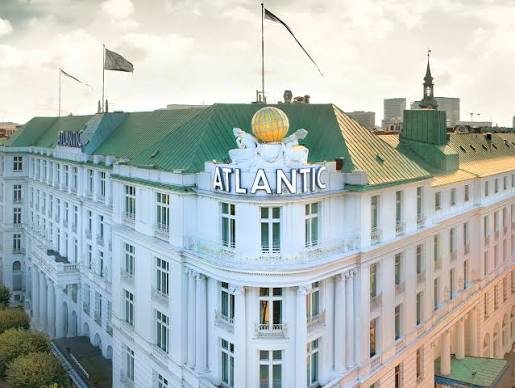
02 — Hotel Atlantic Hamburg, Autograph Collection. Hamburg, an der Alster
The hotel
The Hotel Atlantic opened in 1909 on the shore of the Outer Alster, and the white front facing the water has not changed its role since. It was built as a large city hotel in the grand manner, with a deep lobby, wide corridors and public rooms meant to be crossed slowly. The lake is the reason for the address. Rooms at the front look across open water to the far bank, which is rare for a hotel this close to a city centre. Behind the building the ground rises into An der Alster, a street of nineteenth-century blocks and consulates. The house now runs under the Autograph Collection, so the interior sets newer work against the older structure. Hamburg Hauptbahnhof is a short walk away, which makes arrival simple and also places the ring road on one side of the hotel. It is a building the city uses as a landmark.
Good to know
The hotel sits on a busy road along the lake, so front rooms face both the water and the traffic.
The call
Choose Hotel Oderberger if you want to sleep inside a converted piece of everyday city history, in a residential street, with the 1902 pool as the reason for the trip. Choose the Hotel Atlantic Hamburg if you want a building designed as a grand hotel from the first drawing, open water in front of it and the main station within walking distance.
Pair A2 — Two nineteenth-century city houses
Two large hotels from the second half of the nineteenth century, both in the centre of a major German city, both reworked many times since. One sits in a financial capital that rebuilt almost everything around it. The other sits on a boulevard that was planned as a formal set piece and has kept that role.
03
Steigenberger Icon Frankfurter Hof
Frankfurt am Main
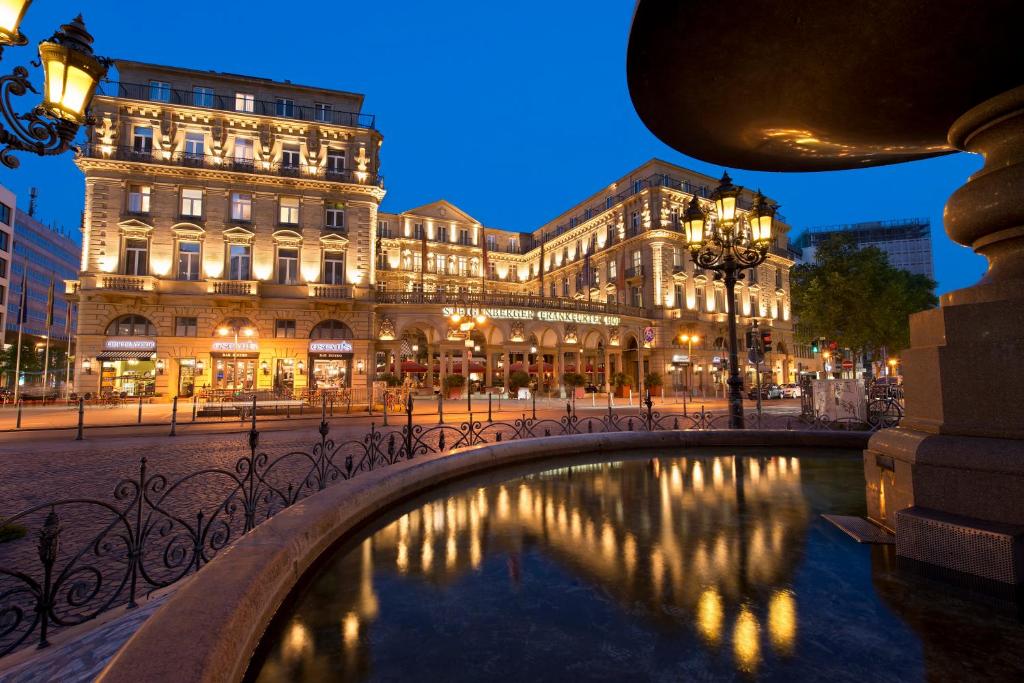
03 — Steigenberger Icon Frankfurter Hof. Frankfurt am Main
The hotel
The Frankfurter Hof opened in 1876, a few streets from the river, and it has stood through every version of Frankfurt since. The building is a solid nineteenth-century block with a stone front, a courtyard and a public ground floor that the city has always treated as a meeting point. Inside, the plan is generous rather than compact: high halls, long corridors, several restaurants and bars on the same level. Rooms vary because the house has been reworked many times, and the older ones keep window proportions that newer hotels do not offer. The address is central in a literal sense, with the banking towers on one side and the old town on the other, both within a short walk. The hotel now carries the Steigenberger Icon name after a rebranding, so the sign outside may not match older guidebooks. Frankfurt Hauptbahnhof and the airport train are both close.
Good to know
Frankfurt fills up during trade fairs, and the streets around the hotel are loud on those weeks.
Side by side
- Setting
- City centreCity boulevard
- Building
- City hotel, 1876City hotel, 1858
- Season
- All yearAll year
- Getting there
- Tram and short walkTram along the street
04
Hotel Vier Jahreszeiten Kempinski München
München, Maximilianstraße
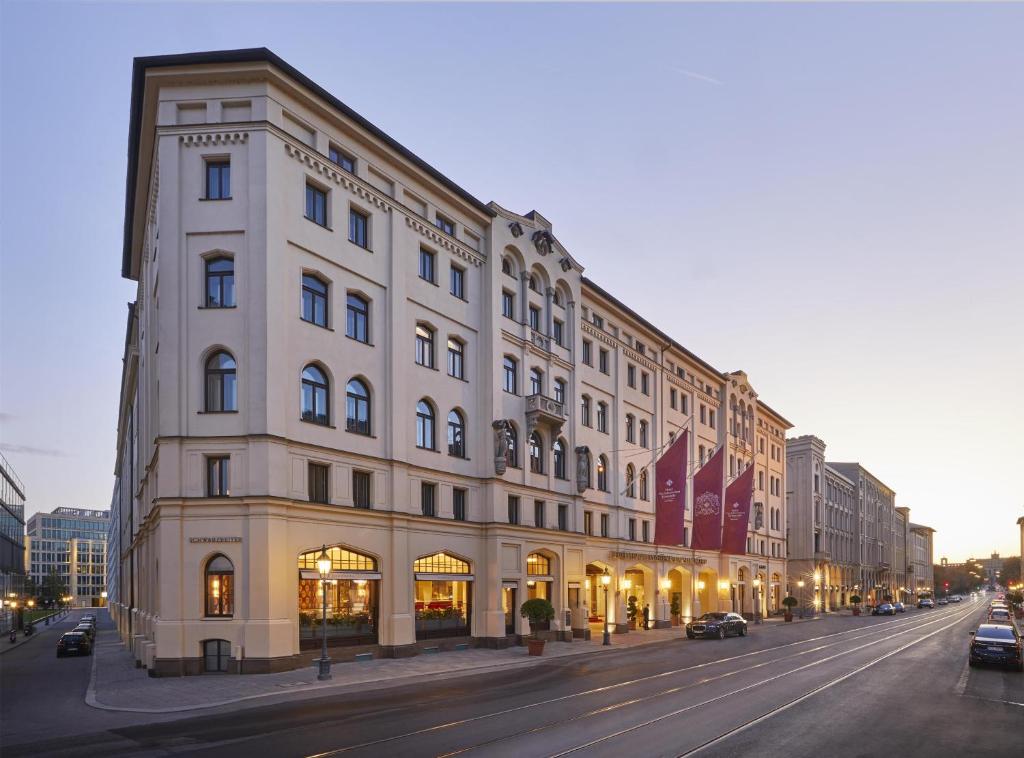
04 — Hotel Vier Jahreszeiten Kempinski München. München, Maximilianstraße
The hotel
The Vier Jahreszeiten opened in 1858 on Maximilianstrasse, the boulevard laid out to give Munich a formal address, and the hotel has been part of that street picture ever since. The building is long and even, with arcades at street level and a facade that follows the rhythm of its neighbours rather than standing apart from them. The lobby runs deep into the block, and the older public rooms keep their scale. Rooms differ between the historic sections and the later ones, and the quieter ones look into the courtyard rather than the street. The setting is straightforward: the Residenz, the Hofgarten and the Nationaltheater are all within a few minutes on foot, and the old town begins one street to the west. The hotel is run under the Kempinski name. For a first visit to Munich it puts almost everything formal within walking distance of the front door.
Good to know
Maximilianstrasse is a shopping street, so the pavement outside is busy through the day.
The call
Choose the Steigenberger Icon Frankfurter Hof if you want a working city hotel at the centre of a place that is constantly rebuilding itself, with the station and the airport train close. Choose the Hotel Vier Jahreszeiten Kempinski München if you want an address on a planned boulevard where the old town, the Residenz and the opera house are all a few minutes on foot.
Pair A3 — Two hotels in the country
Neither of these is a city hotel. One is an eighteenth-century estate on the Baltic coast, spread over many buildings and its own beach. The other is a single nineteenth-century villa in a hill park half an hour from Frankfurt. Both are old buildings in green settings, at very different distances from ordinary life.
05
Weissenhaus Grand Village Resort & Spa
Wangels, Ostsee
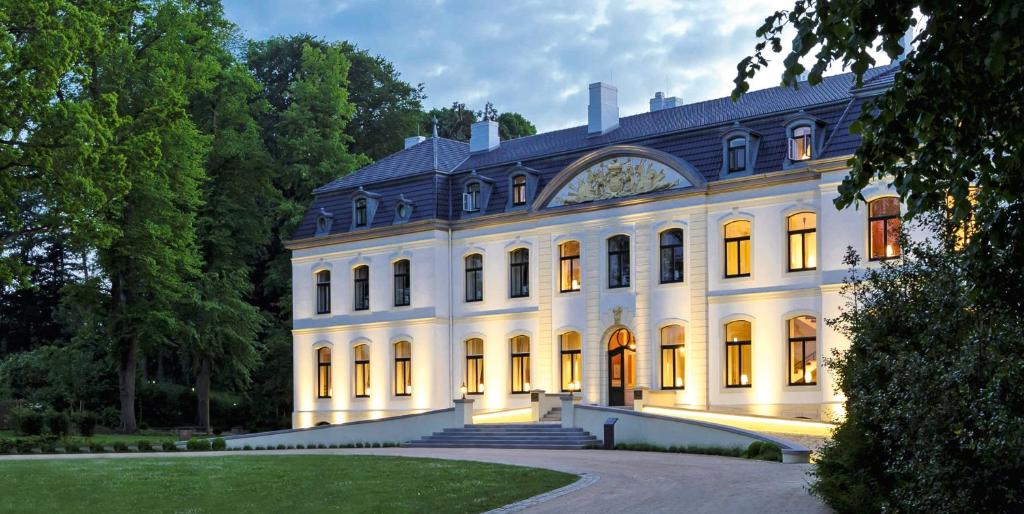
05 — Weissenhaus Grand Village Resort & Spa. Wangels, Ostsee
The hotel
Weissenhaus is not one building but a small estate. The manor house and its farm buildings date from the eighteenth century, and the resort was made by putting rooms into those buildings rather than adding a new block beside them. Guests stay in former barns, gardeners' houses and cottages spread across the grounds, so walking between dinner and bed is part of the stay. The land runs down to the Baltic, and the estate has its own stretch of beach, which is unusual on this coast. Between the buildings there are meadows, a park and working farmland, and the sea is usually audible before it is visible. The setting is Schleswig-Holstein at its flattest and widest: low light, long horizons, wind most days. Winters are quiet and the beach is empty. The name and operator have changed over time, so check the current listing before travelling.
Good to know
The estate is spread out and rural; a car makes the stay much easier.
Side by side
- Setting
- Baltic coast, own beachHill park above Frankfurt
- Building
- Estate village, 18th centuryVilla, 19th century
- Season
- All year, quieter in winterAll year
- Getting there
- Car; nearest station is some way offShort drive or bus from Frankfurt
06
Villa Rothschild, Autograph Collection
Königstein im Taunus
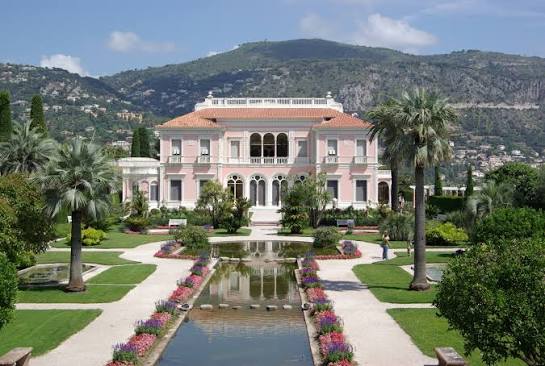
06 — Villa Rothschild, Autograph Collection. Königstein im Taunus
The hotel
The Villa Rothschild is a nineteenth-century summer villa in Königstein, on the slope of the Taunus above Frankfurt. It was built as a private house, and the hotel has kept that scale: a single building with a limited number of rooms, a staircase rather than a lift hall, and windows that look into the park on every side. The park is part of the point. The grounds are planted and mature, the ground falls away towards the plain, and on clear days the towers of Frankfurt are visible from the terrace. Königstein itself is a small hill town with a ruined castle above it and walking routes into the woods from the edge of the built-up area. The house runs under the Autograph Collection. Frankfurt is close enough that guests use the villa as a quiet address for a city stay, which is a different arrangement from a country hotel far from anywhere.
Good to know
It is a small house, and the restaurant and terrace can be fully booked at weekends.
The call
Choose Weissenhaus if you want a whole estate, a private stretch of Baltic coast and enough space that you barely see the road for days. Choose the Villa Rothschild if you want one small house in a park, hills and woodland at the door, and a large city close enough to reach for the evening.
Your picks
You picked 0 of 9
The count lives in this browser tab only. Nothing is stored and nothing is sent anywhere; closing the tab clears it.
Details change. Everything here is accurate to the best of our knowledge as at August 2026. All hotel names belong to their owners; we have no commercial relationship with any of them.